Scorpio Season Stones: A Collector's Guide to Black Tourmaline, Obsidian, and Garnet
Share
One Crystal, One Glass, One Family — And Why It Matters
I see it all the time: three dark stones tossed into the same category, labeled "protection stones," and left at that. Black tourmaline, obsidian, and garnet get treated as interchangeable, but they are fundamentally different materials with different structures, different care needs, and different quality markers. The kind of collector who wants to know her stones, not just accumulate them, will find that distinction matters.
Here it is, plainly: black tourmaline is a true crystalline mineral. Obsidian is volcanic glass, a mineraloid with no crystal structure at all. And garnet is not one stone but an entire mineral family, each species with its own color ideal and value range.
Scorpio season 2026 runs October 23 through November 21, with Mercury retrograde in Scorpio from October 24 to November 13. That overlap makes this a cycle worth approaching with care, especially when choosing grounding and protection stones. This is the slow jewelry approach applied to Scorpio season: deliberate selection over impulse, understanding over aesthetics alone.
Black Tourmaline (Schorl): The Boundary Stone
Its mineral name is schorl, and roughly 95% of all tourmaline found in nature is black. That abundance makes it more accessible in price than its colored cousins (Paraíba, rubellite, watermelon), but accessible does not mean simple. There is a wide range of quality here, and knowing what to look for separates a collector from a casual buyer.
Start with the physical character. Schorl belongs to the trigonal crystal system, registers 7 to 7.5 on the Mohs hardness scale, and displays a vitreous to submetallic luster. The detail most buyers overlook, but collectors recognize immediately, is the parallel vertical striations running along the crystal's length. Those fine grooves are a hallmark of natural tourmaline. If you're holding a smooth, featureless black stone sold as tourmaline, pause and look again.
When evaluating quality, color evenness is the primary grading factor. A collector-grade schorl shows consistent, deep black from the face-up view with no lighter patches or uneven zones. Cut matters second; rectangular shapes are most common because they follow the stone's long prismatic crystal habit, working with the material rather than against it.
Form drives value in predictable ways. Faceted stones command more than cabochons, cabochons more than tumbled or raw. Prices climb significantly above 5 carats, and lab-certified stones carry a 10 to 30% premium over uncertified material. For raw crystal display, specimens from the Paprok Valley in Afghanistan and Pakistan are the ones serious collectors seek.
For jewelry, schorl is a strong choice. Its poor cleavage and hardness of 7 to 7.5 make it well-suited for daily wear, a durability advantage worth keeping in mind when we turn to obsidian next.
In my hands, black tourmaline has always felt like structure. It is the stone I reach for when I need to hold my edges through a season of intensity, when boundary-setting is not optional but necessary. It does not absorb or reflect. It simply holds the line.
Obsidian: Volcanic Glass, Ancient Mirror
Here is the fact most crystal guides skip entirely: obsidian is not a crystal. It is an amorphous volcanic glass, formed when silica-rich lava cools too rapidly for any crystal structure to develop. It has no repeating atomic pattern, no crystal system. Calling it a crystal is technically inaccurate, and for a collector, that distinction shapes everything from how you store it to how you value it.
A simple home authentication test: hold a piece of obsidian in one hand and black tourmaline in the other. Obsidian is noticeably lighter. Its specific gravity sits between 2.35 and 2.60, compared to tourmaline's 3.02 to 3.26. That weight difference is unmistakable once you have felt it, and it also helps you spot dyed glass being sold as obsidian, which tends to feel off in density.
The varieties are where obsidian gets interesting for collectors. Beyond plain black, there is rainbow obsidian, whose iridescent color comes from aligned magnetite nanoparticles; the finest examples come from Jalisco, Mexico. Mahogany obsidian shows black with rust-brown bands created by hematite and magnetite inclusions. Snowflake obsidian features white cristobalite blooms scattered through dark glass. And Apache tears, small rounded translucent nodules from the American Southwest, carry their own quiet beauty and deep cultural significance.
For exhibition-quality black obsidian, Oregon and Yellowstone produce the standard serious collectors reference. Provenance matters here, just as it does with any natural material worth knowing.
Care is where obsidian demands respect. At Mohs 5 to 5.5, it is significantly softer than tourmaline or garnet. Store it separately. Avoid ultrasonic cleaners. A gentle wipe with mild soap and water is all it needs.
Obsidian has been used and traded by humans for at least 700,000 years. Few stones carry that depth of relationship between earth and hand. In my work, obsidian feels like a mirror: it reflects rather than deflects, asking you to look honestly at what lies beneath the surface. The electroformed obsidian arrowhead necklaces in our Scorpio Zodiac Jewelry collection are grown around raw volcanic glass by hand, each one shaped by the stone's own contours.
Shadow work, truth-seeing, the willingness to sit with what you find: that is obsidian's territory, and it is distinct from tourmaline's boundary-setting function.
Garnet: The Honest Stone of Transformation
Garnet is not one stone. It is a family of silicate minerals sharing the same crystal structure but built from different chemical compositions. The five major gem species are pyrope, almandine, spessartine, grossularite, and andradite, and each carries different color ideals, inclusion expectations, and market values. Treating them as one stone is like calling every bird a sparrow.
This matters practically for collectors: fine red almandine cannot be graded by the same standard as vivid orange spessartine (sometimes called Mandarin garnet) or the raspberry-toned rhodolite. Knowing the species is the first step in evaluating quality, and it is the step most guides skip.
Rhodolite is the Scorpio stone I wish more people knew. A natural blend of pyrope and almandine, it shows a distinctive purplish-red color with better brilliance than standard almandine. It is a fresher, more specific recommendation than the generic "deep red garnet" you will find everywhere else.
For red garnets (almandine, pyrope), the quality ideal is straightforward: pure reds without brown modifiers command premiums. Almandine is classified as a Type II clarity stone with a hardness of 7 to 7.5, making it durable for all jewelry applications. Standard almandine and pyrope range from $20 to $200 per carat, while collector-grade spessartine (Mandarin garnet) runs $50 to $400 per carat, with exceptional specimens exceeding $1,000 per carat. Understanding these ranges helps you know what you are investing in.
Here is the trust signal that matters most: garnet is almost never heat-treated. Unlike ruby or sapphire at similar price points, what you see in a garnet is what the earth made. In an era when over 67% of gemstone consumers prioritize transparent supply chains (according to industry research), garnet's honesty is its own kind of luxury. I think of it as the honest stone.
Its role aligns with Scorpio's fixed modality and Mars rulership: courage, commitment, sustained effort. Not the flash of beginning something new, but the resolve to follow transformation all the way through.
Choosing With Intention: What a Collector Actually Looks For
Bringing these three stones together is not about ranking them. It is about asking which one belongs in this particular season of your life.
For tourmaline, look for color evenness and those characteristic surface striations as authenticity markers. For obsidian, hold it; its lighter weight distinguishes it from tourmaline and from dyed glass sold under its name. For garnet, ask for the species name and whether any treatment has been applied (the answer should almost always be no).
The authentication gap is real. Dyed glass is sometimes sold as obsidian. Uncertified tourmaline can be misrepresented. Weight, striations, and provenance documentation are the collector's tools, and they cost nothing but attention.
Store obsidian away from tourmaline and garnet; at 5 to 5.5 Mohs, it will chip against harder stones. All three respond best to gentle cleaning with mild soap and water rather than ultrasonic methods.
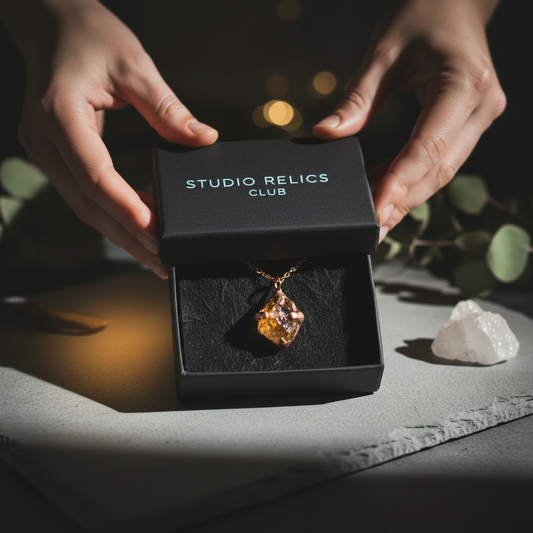
Every stone that comes through my Santa Fe studio has been chosen and held by hand before it ever meets copper or silver. That relationship with material, that willingness to understand what you are holding before you set it in metal, is what slow jewelry means to me. The woman who knows her stones does not just pick the darkest one in the bowl.
Carrying the Season
Scorpio season asks for depth, honesty, and the willingness to sit with transformation rather than rush through it. The stones we choose can hold that intention quietly, close to the skin, where no one needs to see them but us.
Since 2016, every piece that has left this small Santa Fe studio has been grown around its stone by hand. Over 2,500 five-star reviews later, that process has not changed. I still choose each stone the same way I hope you will: slowly, with care, with the patience to understand what the earth actually made before deciding it belongs with you.
If one of these stones is calling to you this season, I am here. A custom commission can build a one-of-a-kind talisman around the exact stone that feels right. There is no rush. Scorpio never asks us to hurry.