Amber, Jasper & Petrified Wood: An Autumn Studio Guide
Share
Before They Were Jewelry, They Were Time
There is a moment at the bench, just before I begin working, when I hold a stone in my palm and simply feel the weight of it. This morning it was a piece of amber, warm as a held breath, golden as late October light. And the strangeness of it settled over me: this small, glowing thing is older than memory. Older than language. Older than anything I could name.
Amber, jasper, and petrified wood are not decorative materials. They are geological archives, literal time capsules of Earth's ancient forests. Amber is fossilized tree resin. Petrified wood is fossilized tree structure. And jasper is the mineral most likely to have replaced that wood during petrification. All three are born from the same story: the slow, patient transformation of forests that stood millions of years ago.
Autumn is the season of harvest, memory, and intentional release. These three stones carry exactly the energy this season asks for. This is a maker's guide, written from the bench in my Santa Fe studio, not a textbook. Let me walk you through them.
Amber: Sunlight That Never Left
Amber is fossilized tree resin. Not a mineral, but an organic gemstone and a fossil, formed from ancient coniferous trees over timescales that stagger the imagination. The oldest amber on record dates to the Upper Carboniferous Period, roughly 320 million years ago. Baltic amber, the most commercially significant deposit and the variety I work with most often, is between 25 and 60 million years old.
The ancient Greeks called amber elektron, meaning "made by the sun." Homer praised its bright glow. The Egyptians buried it in tombs, trusting it to carry light into the afterlife. It has been used in folk medicine, perfume, and adornment since Neolithic times. Six tons of it were used to construct the Amber Room, gifted to Russia's Peter the Great in 1716. This is a material that has held human reverence for as long as humans have been capable of reverence.
One of amber's quiet virtues is its lightness. Composed primarily of carbon, hydrogen, and oxygen, even large pieces cause no discomfort on the body. You can wear a substantial amber pendant all day and forget it is there, except for the warmth.
In crystal traditions, amber is associated with the solar plexus chakra: authenticity, manifestation, the courage to be seen. This is the energy autumn calls forward, the season's last invitation to shine before winter's quiet inward turn. Astrologically, amber resonates with Taurus, a sign that understands the value of patience and the beauty of things that take their time.
And that is amber's deepest teaching. It preserves life across millions of years, the ultimate metaphor for patience and the long becoming. Baltic amber is sustainably harvested from the Baltic Sea, gathered from shorelines and shallow waters with minimal intervention. It arrives in my studio already warm, already golden, already carrying its ancient light.
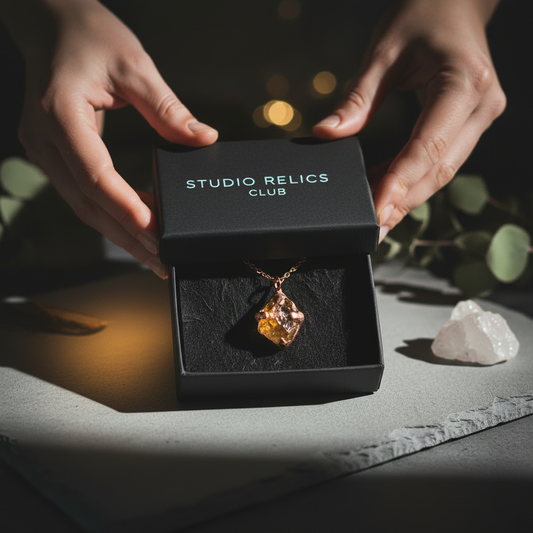
Set in electroformed copper, amber is extraordinary. The warm gold of the stone against the earth-red patina of the metal creates something that looks like it was pulled from the ground whole, as if it had always been that way.
Jasper: The Earth That Held Everything
Jasper is an opaque, microcrystalline form of quartz, and one of the most ancient spiritually used gemstones on Earth. It has been revered across Persian, Syrian, and Native American traditions for thousands of years, shaped into jewelry, bowls, and ceremonial objects.
Here is the geological detail that makes jasper uniquely relevant to this autumn trio: jasper is the mineral most commonly responsible for petrification. When ancient wood was buried in mineral-rich sediment, it was often jasper that slowly replaced the organic matter, cell by cell. Petrified wood is, in many cases, literally jasperized wood. The three stones in this guide are not just thematically linked. They are geologically intertwined.
In crystal traditions, jasper is known as the Supreme Nurturer: grounding, protective, stabilizing. Its autumn-relevant colors read like a map of the changing forest. Red jasper aligns with the root chakra, offering grounding and security. Brown jasper deepens the connection to the earth itself. Yellow jasper warms the solar plexus, mirroring the last golden light before the leaves fall.
Native American traditions used jasper for protection during travel and for connecting with the spirit world. There is ancestral wisdom carried in this stone, a quiet knowing that predates written language.
In the studio, jasper holds light differently than polished stones. Its matte, earthy surface absorbs rather than reflects, and it looks like the forest floor after rain. When I set jasper in electroformed copper, the organic texture of the metal mirrors the stone's own roughness. Jasper's density gives it a grounding physical presence on the body. You feel it. It reminds you where your feet are.
Petrified Wood: The Forest That Remembered
Petrified wood is ancient wood buried in mineral-rich sediment, its organic matter slowly replaced by silicates: jasper, chalcedony, quartz, opal. The process can take as little as 100 years, but many specimens span hundreds of millions of years. The oldest known petrified wood dates to the Devonian era, approximately 390 million years ago. Hold that number in your mind. 390 million years.
Petrified wood is both fossil and crystal simultaneously, a rare dual identity that makes it unlike any other stone I work with. It remembers what it was. The grain of ancient wood is still visible, the rings and textures preserved in mineral. No two pieces carry the same pattern, because no two trees lived the same life.
The Ancestral Puebloans, who lived in what is now the American Southwest, used petrified wood as a building material. They treated it as a symbol of stability and durability, an example of ancestral wisdom literally encoded in stone. The Petrified Forest National Park in Arizona, 346 square miles of ancient earth memory, stands as a touchstone of this deep American landscape. Living in Santa Fe, I feel the presence of that history in everything I make.
Petrified wood is associated with the root chakra for grounding and security, and the third eye chakra for ancestral memory and past-life wisdom. That combination feels made for autumn's inward turn, the season when we stop reaching outward and begin listening to what is already within us.
This is the slow-living stone. It teaches patience, transformation, and trust in the long process. In a moment when so many of us are learning to value slowness over speed, petrified wood feels less like a trend and more like a teacher. In the studio, I turn each piece in my hands and trace the grain with my thumb. The visible wood pattern, preserved in stone, is a kind of miracle I never tire of.
How to Wear Earth's Oldest Materials This Autumn
These are my own recommendations, gathered from a decade of working with these stones at my bench. Take what resonates and leave the rest.
- Amber wears beautifully close to the solar plexus. A pendant at mid-chest, worn during mornings when you need clarity and the courage to show up fully. Its lightness makes it easy to layer.
- Jasper is a daily grounding stone. I recommend it in ring or bracelet form for days that feel unmoored or overwhelming. Red and brown jasper especially bring a steadying weight that you can feel against your skin all day.
- Petrified wood is for the quieter practices: meditation, journaling, new moon rituals. Held in the hand or worn as a pendant during reflective, inward work, it opens a door to ancestral memory and deep patience.
Worn together, the three create a complete autumn palette: the warm gold of amber, the earthy matte of jasper, the wood-grain texture of petrified wood. Set in electroformed copper, they share a visual language of warmth, age, and organic beauty.
A care note for amber specifically: because it is organic, it responds to its environment. Avoid heat, harsh chemicals, prolonged direct sunlight, and ultrasonic cleaners. Treat it gently, and it will carry its glow for generations.
All three stones are available in my current collection. If you have a stone of your own that you would like set in copper, custom commissions are always welcome. Every piece begins with a conversation.
A Closing Note from the Studio Bench
I come back to that moment at the bench. The amber in my palm, warm and impossibly old. The jasper beside it, dense as packed earth. The petrified wood with its visible grain, a tree that refused to disappear.
Wearing these stones in autumn is a form of seasonal ritual: a way of aligning with the earth's own rhythm of harvest and release. They took unimaginable time to become what they are. Perhaps autumn is asking the same patient becoming of us.
If you are drawn to this kind of quiet, intentional work, the Studio Relics Club brings a handcrafted piece to your door each month for $25, each stone chosen for energetic integrity and natural beauty. After ten years and over 2,500 five-star reviews, this studio still runs on the same principle it started with: one stone, one pair of hands, one slow and careful growing of copper around something ancient.
The earth kept these stones for millions of years. Now they are ready to be worn.