Copper Ring Sizing: What to Know Before You Buy
Share
Your Finger Is Not a Fixed Size. Neither Is Copper.
I've been growing copper rings in my Santa Fe studio since 2016, and if there's one truth I return to again and again, it's this: copper is a living metal. It breathes. It darkens. It responds to the air, to the season, to you.
So when someone tells me they're nervous about buying a handcrafted copper ring online, I understand completely. What if it doesn't fit? What if it's too loose in winter or too snug in July? These are real concerns, and I want to honor them honestly.
Both the copper and your finger are dynamic systems. Neither one stays exactly the same from day to day. By the time you finish reading this, you'll know exactly how to measure, when to measure, and what to expect from a copper ring as it lives on your hand over time.
The Living Metal: How Copper Actually Behaves on Your Finger
Copper expands and contracts with temperature. It has a measurable thermal expansion coefficient, and yes, the metal itself does shift slightly between a freezing January morning and a scorching August afternoon. But the actual change in a ring's diameter under normal seasonal temperatures? A fraction of a millimeter. Barely perceptible.
The bigger variable isn't the copper. It's you.
Your fingers can fluctuate by up to half a ring size between hot and cold seasons. In summer, blood vessels expand and your body retains more fluid, so your fingers swell. In winter, vessels constrict and fingers slim down. The ring that sits perfectly against your skin in September may spin freely by December.
I don't think of this as a problem. I think of it as part of the rhythm of wearing copper, the way it moves through the year with you. Some of my customers tell me they rotate between rings with the seasons, the way they rotate between heavier and lighter clothes. That feels right to me.
Over time, copper naturally darkens through oxidation, developing a patina that's unique to each piece. This patina isn't just beautiful; it actually builds up to a point where it can slow the formation of verdigris on your skin. Verdigris is that green mark some people notice, and it's worth understanding what it actually is: a harmless chemical reaction between copper, your sweat, and oxygen. It forms copper carbonate or copper chloride on the skin's surface. It is not an allergy. It is not a flaw. It's authentic copper meeting real body chemistry.
Nickel allergy, by contrast, is a genuine immune response that affects more than 18% of people in North America. All of my pieces are nickel-free for exactly this reason. Verdigris and nickel allergy are entirely different things, and knowing the difference can save a lot of unnecessary worry.
The Electroforming Difference: Why These Rings Fit Differently
Every ring I make is electroformed, which means copper is literally grown around each stone by hand in my studio. The metal builds up slowly, atom by atom, in a copper sulfate bath. Nothing is cast, stamped, or manufactured on a production line.
Because electroformed copper isn't annealed (heat-treated to soften the metal), it's sturdy but not designed to be forcefully bent or twisted. If you order an adjustable electroformed ring, adjust it slowly and gently, by no more than one to two sizes. Forcing it risks cracking the copper.
The interior of an electroformed ring may feel slightly different from a smooth cast band. You'll notice organic surface texture and variable wall thickness. This is intentional craft, not imperfection. It's also why sizing education matters more for electroformed pieces: resizing options are more limited than with traditional cast metals.
No two of my rings are identical. That's the whole point. And it's exactly why I want you to take sizing seriously before you order.
Wide Bands, Narrow Bands, and the Knuckle Nobody Talks About
Here's something most sizing guides skip over: band width changes how a ring fits. A 6mm band feels noticeably snugger than a 2mm band at the same numerical size. An 8mm band can feel downright restrictive. The wider the band, the more friction it creates against your skin, especially over the knuckle. For bands 8mm and wider, I recommend sizing up at least half a size.
For wide bands with a flat interior, sizing up about a quarter size usually does the trick. Comfort-fit bands (the ones with a gently rounded interior) glide over the knuckle more easily and may even allow you to stay at your standard size or size down slightly.
Now, the knuckle problem. If your knuckles are significantly larger than the base of your finger, you know the dilemma: the ring has to be big enough to clear the knuckle but small enough to stay put once it's on. Wide bands make this harder because they create even more friction during that pass over the joint.
If this is your finger shape, size for the knuckle first. Then consider a slightly adjustable style, or reach out to me directly for a custom consultation. This is one of the most common fit complaints in handmade jewelry, and almost no sizing guide addresses it head-on. You're not imagining it. It's real, and there are solutions.
How to Measure at Home (and When to Do It)
Measuring your ring size at home isn't a chore. Think of it as a small act of body awareness, a few quiet minutes of paying attention to yourself. It fits right into the slow, intentional approach you probably already bring to the things you care about.
The method I recommend is the GIA paper-and-string technique. Here's how it works:
- Cut a thin strip of non-stretchy paper or use a piece of string.
- Wrap it snugly around the base of the finger you plan to wear the ring on.
- Mark the point where the strip overlaps.
- Lay it flat and measure the length in millimeters.
- Compare that measurement to a ring size chart.
When you measure matters as much as how. The best time is at the end of the day, when your fingers are warm and slightly swollen. This gives you the most accurate fit for everyday wear. If you measure first thing in the morning or when your hands are cold, you'll likely end up with a ring that feels too tight by evening.
Other factors can shift your finger size at the moment of measurement: hydration levels, salt intake, recent exercise, hormonal fluctuations. These aren't obstacles. They're just things to be aware of. I recommend measuring at least two or three times across different days and different times of day before placing an order, especially for a made-to-order piece.
And if you fall between sizes? Consider the band width, your knuckle shape, and the time of year. A wider band in summer might warrant sizing up. A narrow band in winter might be fine at the smaller size. When in doubt, reach out to me directly. I'd rather spend ten minutes helping you get it right than have you receive something that doesn't feel like it was made for you.
Your Body Chemistry Is Part of the Story
How copper interacts with your skin is deeply personal. Your skin's pH, the composition of your sweat, your diet, hormones, even your stress levels all influence how quickly and intensely verdigris forms. Two people can wear the exact same ring, and only one will see green. This isn't a quality issue. It's personal chemistry meeting an earth metal.
I offer a sealant option on my electroformed pieces that reduces direct skin contact with the copper surface, which can minimize or eliminate verdigris for those who prefer it. All my stones are ethically sourced, and every piece is nickel-free, so if you have sensitive skin, the sealant is worth considering.
But I also want to say this: verdigris washes off with soap and water. It poses no health risk. And it often diminishes on its own as the copper's patina builds over time. The ring is responding to you, specifically. There's something honest and kind of beautiful about that.
Before You Click 'Add to Cart': A Maker's Honest Checklist
Before you order, take a moment to consider these things:
- Band width: Wider bands need a larger size. Know which style you're drawn to.
- Knuckle shape: If your knuckles are larger than your finger base, size for the knuckle and consider an adjustable design.
- Time of day: Measure at the end of the day, when fingers are warm.
- Fixed or adjustable: Decide which you prefer, keeping in mind that adjustable electroformed rings should only be shifted one to two sizes.
Roughly 15% of rings bought online are returned specifically for sizing issues. A handcrafted, made-to-order piece deserves more care than a quick guess. Take the extra few minutes. Measure twice. Your future self will thank you.
If you have questions, I'm a real person in a real studio, and I'm happy to help. With over 2,500 five-star reviews and a community of loyal Wild Keepers Circle members, the relationship I have with the people who wear my work is something I protect fiercely. Custom commissions are always an option if you have truly unique sizing needs or want a piece built around your own stone.
Getting the size right is an act of honoring the piece and honoring yourself. It's part of the slow, intentional way of acquiring something made by hand, something grown in copper and meant to live on your body for years.
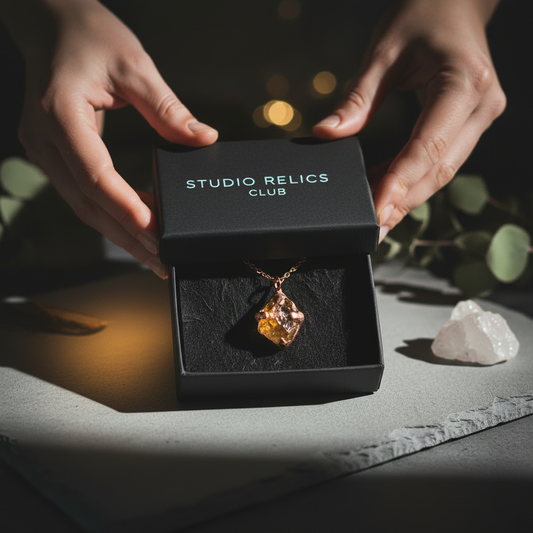
Visit my ring size guide for detailed measurements, explore the current ring collection, or join the Studio Relics Club to receive handcrafted pieces delivered to your door each month. I'll be here, at the bench, growing the next one.