The Grief Stone and the Joy Stone: Wearing Both at Once
Share
You Don't Have to Choose Between the Ache and the Light
A woman came into my Santa Fe studio last autumn wearing obsidian on one wrist and citrine on the other. One for what she lost. One for what she was still becoming. She didn't explain it right away. She just held out both wrists and said, "I need you to know I'm both of these right now."
I've watched women come into my studio carrying both things at once, the ache and the aliveness, and not know what to do with either. We've been told grief and joy are opposites, that you must finish one before you're allowed the other. But that's a myth. The grief stone and the joy stone worn together is not a trend. It's a return to something ancient, something the body already knows.
What follows is the neuroscience, the history, and a practical framework for wearing both ends of the emotional spectrum at once.
The Brain Was Built for Both: The Neuroscience of Emotional Ambivalence
Psychologists have a name for the brain's ability to hold grief and joy simultaneously without one canceling the other out. They call it emotional ambivalence. It sounds clinical, but the experience is anything but. It's the laugh that rises in the middle of a eulogy. It's the sudden, startling beauty of a sunset on the worst day of your life.
Neuroscientists have found that positive and negative feelings light up overlapping regions of the brain, particularly the prefrontal cortex and the limbic system. Duality isn't a contradiction. It's neurologically native. Your brain was literally built to hold both.
Bereavement research confirms something even more striking: people who allow joy to surface during grief heal faster and develop stronger long-term resilience than those who suppress it. Letting the light in doesn't betray the loss. It supports your capacity to survive it.
There's a related concept called emotional granularity, the ability to name specific feelings rather than collapsing everything into "sad" or "happy." Greater granularity is linked to greater psychological flexibility and emotional resilience. Choosing a stone for a specific feeling is a physical form of this practice. It names the feeling. It gives it weight and texture. It keeps it present without demanding resolution.
A stone chosen with intention becomes a tangible anchor. Not a cure, not a fix. Just a way of saying: I know what I'm carrying today, and I'm carrying it on purpose.
Women Have Always Known This: A Brief History of Stones and Sorrow
Long before psychology gave us frameworks for processing loss, people around the world reached for stones. The instinct to hold something solid during the most unsolid moments of life is ancient and cross-cultural.
Victorian mourning culture formalized this instinct into a social practice. After a death, women wore jet, black onyx, and hair lockets for years, sometimes decades. These weren't decorative choices. They were emotional declarations, visible signals that the wearer was still in the territory of loss and should be met with tenderness.
This isn't a historical curiosity. It's a continuous cultural lineage. The modern intentional jewelry movement is the same impulse in new form. What's shifted in the 21st century is the expression: mourning jewelry has moved from social convention to deeply personal, individualized practice. Gemstones appear in unexpected colors and combinations. The grief piece no longer needs to be black. It just needs to be yours.
The dual-process model of grief, recognized in the ICD-11 and DSM-5 frameworks in 2022, confirms what women have practiced for centuries: healthy grieving oscillates between loss-oriented and restoration-oriented states. You don't stay fixed in one emotion. You move between them, sometimes within a single hour.
My grandmother wore a locket. Psychologists call it emotional ambivalence. Women have always known the heart holds more than one thing at a time.
The Stones Themselves: Choosing Your Grief Stone and Your Joy Stone
The practice is simple in structure: one stone for what was lost, one stone for what remains or is becoming. Worn together, not in sequence. Not one replacing the other, but both present, both real.
Grief Stones
Apache tears are where I often start with someone new to this practice. They're a form of obsidian, but gentler. They offer release without overwhelm, like a long exhale you didn't know you were holding. For grief that feels too big to face head-on, Apache tears create a softer entry point.
Obsidian is for deeper processing. It's the stone of truth-facing, of looking at what happened without flinching. Not everyone is ready for obsidian right away, and that's fine. It will wait.
Rose quartz addresses a different layer entirely: self-compassion after loss. When grief turns inward and becomes self-blame, rose quartz is the stone that says, you did enough. You are enough.
Joy Stones
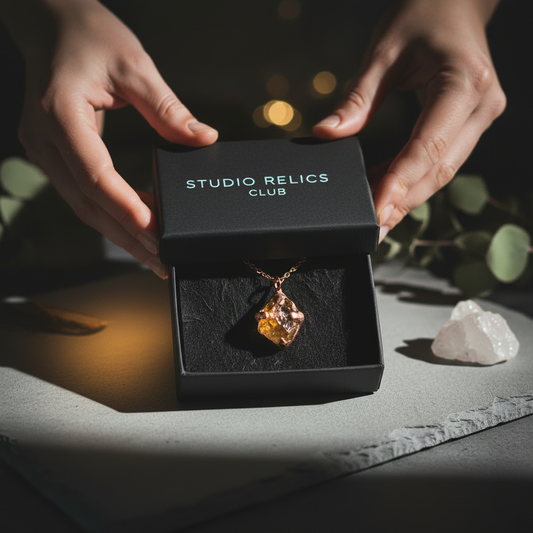
Citrine is the classic stone of vitality and positive energy, warm as afternoon light through honey. It doesn't force brightness. It invites it.
Sunstone carries warmth and renewal, the feeling of stepping outside after a long winter. It's particularly resonant for women in the early stages of rebuilding.
Golden labradorite holds a quieter kind of joy, the light that lives inside transformation itself. It's for the woman who isn't yet sure what she's becoming but can feel the shift happening.
I want to name something important here: grief extends far beyond death. Divorce, infertility, identity loss, career endings, estrangement. These are all valid griefs that deserve a stone. You don't need a funeral to earn the right to grieve.
And I want to name the guilt, too. So many women feel guilty about experiencing joy during grief, as if happiness were a betrayal of the loss. Wearing a joy stone alongside a grief stone is a radical act of self-permission. It says: I will not abandon my sorrow, and I will not abandon my aliveness either.
Every stone I select for the studio is chosen for its individual energetic integrity and natural character. No two are identical. The character of the stone mirrors the character of the grief, which is always personal and unrepeatable.
How to Wear Them: A Simple Ritual Framework for the Dual Talisman
This isn't doctrine. It's an invitation. Take what resonates and leave the rest.
Consider wearing your grief stone closer to the heart or on your dominant hand, and your joy stone on the opposite side. If you prefer pendants, layer them at different lengths so each rests at a different point on your chest. The physical separation creates a felt sense of holding both, not blending them into one undifferentiated feeling, but honoring each distinctly.
A smooth stone pendant worn close to the skin offers a grounding sensation throughout the day, similar to a worry stone. It becomes a mindfulness anchor during emotional transitions, something to reach for when the feelings shift without warning.
The daily act of putting them on can become its own quiet ritual of self-acknowledgment: I am holding both things today. I am allowed to.
More and more women are building jewelry stories over time, adding a grief stone during loss and a joy stone during renewal, creating a wearable timeline of the inner life. If you have a stone that already carries meaning for you, a family heirloom or a rock from a place that mattered, I offer custom commissions where we can work with your stone and grow copper around it. The pairing becomes something only you could have made.
You Are Allowed to Feel Both
The grief stone and joy stone practice is not about balance. It's not about resolution. It's about permission.
There is a cultural pressure women face to perform either grief (stay sad long enough to prove the loss mattered) or recovery (bounce back quickly to prove your strength). Intentional jewelry quietly refuses both demands. It says: I will move at my own pace. I will feel what I feel.
When I set a grief stone next to a joy stone in a single piece, I'm not trying to fix anything. I'm just saying: both of these are real. Both of these are yours.
You might choose two stones from the shop, commission something custom, or simply sit with the idea that you are allowed to hold more than one feeling at once. The practice begins the moment you give yourself permission.
After ten years of growing copper around stones in my studio, after more than 2,500 reviews from women who have trusted me with their most personal stories, I keep returning to the same image: a river holding both shadow and light on its surface at the same time. Neither cancels the other. Both are the river. Both are real.